
What if many of the difficulties children experience in mathematics do not begin with fractions, algebra or long division—but much earlier, in the way they first learn to understand number?
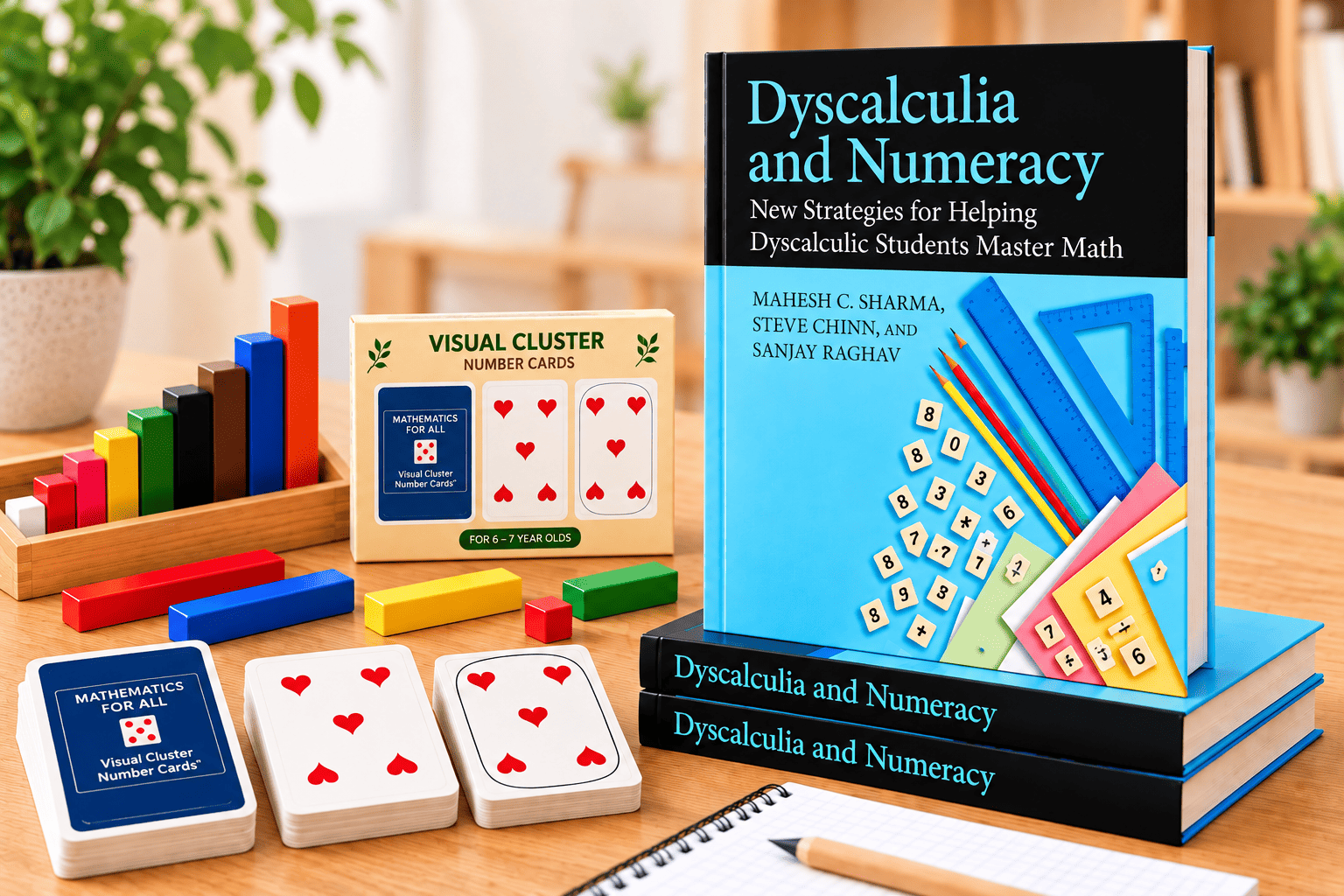
For generations, children's earliest encounters with mathematics have been dominated by counting. We count objects, count fingers, count forward to add, count backwards to subtract and later skip-count for multiplication and division.
Counting is important. But counting is only one part of becoming numerate.
This apparently simple distinction opens the door to a different way of thinking about number, number sense, numeracy and the teaching of mathematics.
To know seven is more than knowing that seven comes after six and before eight.
A child can gradually learn to perceive seven as a quantity and recognise the relationships contained within it. Seven can be six and one, five and two, four and three, and many other combinations.
Number therefore becomes something the learner can see, decompose, recompose, relate and manipulate rather than something that must repeatedly be reconstructed through counting.
Professor Mahesh C. Sharma describes this spontaneous understanding of relationships within numbers as sight facts.
Consider something as simple as 8 + 6. Two children can reach 14 while engaging in very different kinds of mathematical thinking.
The answer may be correct, but the learner can remain dependent upon a counting procedure rather than recognising the mathematical relationships contained within the numbers.
As numbers become larger, repeated counting can become increasingly cumbersome and inefficient.
The learner begins to seek relationships, recognise patterns, decompose and recompose quantities and choose efficient mathematical pathways.
Counting has an important role. The concern arises when counting remains the principal strategy through which children understand and operate with number.
Recognising quantities without individually counting every object.
Organising quantity so that meaningful numerical structures become perceptually available.
Developing immediate awareness of important relationships contained within numbers.
Breaking numbers apart and recomposing them in mathematically useful ways.
Using ten as a powerful numerical anchor for efficient mental computation.
Extending relationships to larger quantities and developing increasingly flexible strategies.
Recognising, extending and creating patterns and relationships within mathematics.
Selecting and adapting strategies according to the structure of the mathematical problem.
The comparison does not suggest that learning to read and learning mathematics are identical. Instead, it raises an important question: can mathematics education also identify foundational processes and teach them explicitly and systematically?
Reading fluency does not emerge simply from repeated exposure to printed words.
Learners develop underlying processes involving the structure of spoken and written language, including phonemic awareness, phonics, morphology, vocabulary, knowledge and comprehension.
Mathematical fluency need not be built principally upon repeated counting and memorisation.
Children can develop subitizing, visual clustering, sight facts, decomposition and recomposition, number relationships and flexible mental manipulation.
Numeracy instruction can draw upon several interacting bodies of knowledge rather than mathematical content alone.
Cognitive development, brain functioning and plasticity, attention, memory and processes involved in learning.
Mathematical language, concepts, conceptual schemas, procedures and relationships.
Effective teaching principles, instructional sequencing, strategies and meaningful mathematical experiences.
Understanding children's development, strengths, difficulties and existing mathematical schemas.
Using formative assessment, practice and feedback to determine what a learner understands and what should happen next.
Choosing representations that reveal mathematical structure rather than simply helping children obtain an answer.
Mathematical tools and instructional approaches are situated within CPVA/S — integrating Concrete, Pictorial, Visualization and Abstract models with the resultant mathematical Script.
The purpose is not merely to move children from physical objects towards symbols. Representations should help learners build conceptual schemas, develop mathematical language, visualize relationships and communicate mathematical ideas.
A useful mathematical tool does more than provide a physical route to an answer. It should reveal structure, support mathematical language and contribute to the development of conceptual schemas.
Make quantities and their internal relationships visually accessible.
Support recognition of important relationships within numbers.
Provide physical and spatial representations of number relationships.
Provides a representation through which numerical relationships and strategies can be expressed.
Supports the exploration and communication of mathematical relationships.
Support movement between experience, imagery, visualization, abstraction and mathematical communication.
Children should be able to understand the mathematics through the strategy, representation or tool being used.
Mathematical strategies should avoid unnecessary demands on attention and working memory when a more direct mathematical relationship is available.
What children learn today should be capable of being generalized, extrapolated, abstracted and applied to the mathematics they encounter tomorrow.
Early strategies eventually have to support increasingly sophisticated mathematics. A method that works on today's worksheet but cannot be generalized may provide a weak foundation for tomorrow's mathematics.
Diagnosis is important, but it cannot be the end of the inquiry. Persistent mathematical difficulty requires us to consider the learner alongside instruction, intervention, remediation, mathematical tools, language and the strategies through which the learner has encountered number.
Some learners experience genuine neuropsychological, cognitive, linguistic or other learning differences that affect mathematical development.
Mathematical difficulties can also be created or compounded by insecure foundations, inappropriate materials, inefficient strategies, fragmented instruction or prolonged dependence on counting.
If weak number concept contributes to later mathematical difficulty, then strengthening initial instruction is not merely remediation. Better foundations may help reduce the development or intensity of some later difficulties.
The aim is not simply to replace one collection of procedures with another.
Learners should increasingly move beyond absolute reliance on rote learning and formulaic solutions towards understanding, relationships and alternative explanations.
Strong number sense allows learners to seek connections, explore alternatives and approach mathematical problems flexibly.
Creativity, however, requires confidence. Secure foundations help learners explore mathematics rather than merely survive it.
The ideas are relevant not only to specialists working with dyscalculia, but to anyone concerned with how mathematical understanding develops.
For understanding how strong mathematical foundations can be built through everyday instruction.
For examining the foundations underlying persistent mathematical difficulty.
For designing intervention that develops relationships rather than simply rehearsing procedures.
For engaging with questions concerning number sense, dyscalculia, instruction and numeracy development.
For understanding not only what children should know, but how mathematical understanding develops.
For considering the mathematical knowledge, pedagogy and tools teachers need to teach numeracy effectively.
Counting is natural, useful and important. The concern arises when it remains the principal strategy for understanding and operating with number. Learners also need to perceive quantity, recognise structure and develop relationships within and between numbers.
Sight facts involve spontaneous recognition of relationships within numbers—for example, seeing seven as five and two, four and three, or six and one—rather than reconstructing the quantity through counting every time.
Visualization helps learners internalise mathematical relationships so understanding does not remain permanently dependent upon physical objects. Within CPVA/S it provides an explicit component in the development towards abstraction and mathematical communication.
An efficient strategy makes use of mathematical relationships directly and avoids unnecessary demands upon attention and working memory when a more direct pathway is available.
Because persistent mathematical difficulty may involve both characteristics of the learner and the quality of the mathematical foundations, materials, language, strategies and instruction the learner has encountered.
If insecure number concept can contribute to later difficulty, strengthening initial instruction may reduce the development or intensity of some later mathematical problems.
Just as a fluent reader increasingly looks at print and sees meaning, a numerate learner should increasingly be able to look at numbers and perceive quantity, structure, relationships, patterns and possibilities.